

At 11 17 US. 16-402 holding that law enforcement absent exigent circumstances must get a warrant to obtain cell-site location information CSLI that extends over a period of time.
Carpenter V United States Oral Argument C Span Org
United States the US.
Carpenter v us 2018. 16-402 June 22 2018 a closely watched criminal case addressing whether law enforcement officials can secure cell-site location information without a warrant issued on probable cause. The case is the latest to interpret how to apply the Fourth Amendment to modern technology. United States 267 US.
In a 5-4 ruling the court decided in Carpenter v. In late June the United States Supreme Court issued its ruling in Carpenter v. Argued November 29 2017Decided June 22 2018.
As cited in Carpenter v. On June 22 2018 the United States Supreme Court decided Carpenter v. UNITED STATES 138 SCt.
UNITED STATES 138 SCt. The 1976 case US. 2206 2018 Timothy Ivory CARPENTER Petitioner v.
United States that the government generally needs a warrant in order to access cell site location information. CERTIORARI TO THE UNITED STATES COURT OF APPEALS FOR THE SIXTH CIRCUIT. See Carpenter slip op.
See United States v. The Court established that if you hand information over to a third party voluntarily then you cant expect privacy in it. After a series of robberies around Detroit police arrested four men.
Opinion Ysis Court Holds That Police Will Generally Need A Warrant For Sustained Cellphone Location Information Updated Scotus. The government doesnt need a warrant to get it. SUPREME COURT OF THE UNITED STATES.
United States 138 SCt. Making Cents Out of United States v. Bankston Ashkan Soltani Tiny Constables and the Cost of Surveillance.
In its newly released decision on Carpenter v. This originally seemed to me to be a reasonable position regarding an individuals right to be secure in their persons. Criminal Procedure Fourth Amendment.
On June 22 2018 the United States Supreme Court appeared to establish a new standard for privacy rights when its decision in Carpenter vUnited States 2018 BL 222220 2018 held that the governments acquisition of a defendants historical cell-site location information CSLI from a third party constituted a. See United States v. The ACLU along with the ACLU of Michigan Brennan Center Center for Democracy Technology Electronic Frontier Foundation and National Association of Criminal Defense Lawyers filed an amicus brief arguing that the government violated the Fourth Amendment when it obtained the location records from Carpenters wireless carrier without a warrant.
Supreme Court of United States. In Carpenter v United States 585 U. Supreme Court held that the seizure of cell-site location information constitutes a search under the Fourth Amendment.
Cell phones perform their wide and growing variety of functions by con-. Supreme Court Opinions 2018 CARPENTER v. This article was originally published in Bloomberg Law on July 9 2018.
Supreme Court has downloaded a necessary update to its Fourth Amendment jurisprudence on unlawful search and seizure. United states court of eals for the supreme court says warrant necessary covid 19 digital surveillance and decided june 22 carpenter decision requires warrant. Carpenter moved to suppress the governments cell-site evidence on Fourth Amendment grounds arguing that the FBI needed a warrant based on probable cause to obtain the records.
Carpenter sits at a juncture in two lines of expectation of privacy cases. ____ 2018 the US. United States 585 US.
Miller was about bank records and the ruling also applied in 1979 to phone numbers that were dialed or given to a phone company Smith. Detroit Timber Lumber Co 200 U. Carpenter V Us 2018 Case Brief.
The district court denied the motion to suppress and the Sixth Circuit affirmed. 1 the expectation of privacy one has in their physical location and movements and 2 the expectation of privacy one has in information willingly turned over to a third party. The court uses the point that individuals have a reasonable expectation of privacy in the whole of their physical movements as the determining factor for the requirement for a warrant.
Carpenter V United States 2018 Case Brief By Azka August 18 2020 Case no 19 35428 in the united states in carpenter the supreme court rules fourth amendment reasonableness after m v ohio inquiry based task what case brief 4 name and citation.

Carpenter V United States American Civil Liberties Union
Carpenter V United States Oral Argument C Span Org
The Broad Reach Of Carpenter V United States Just Security

Supreme Court Bans Police Access To Phone Records Without A Warrant Us Supreme Court The Guardian

Sabrina Carpenter V Magazine Photoshoot Winter 2018 Part Ii Celebmafia

Future Proofing The Fourth Amendmentharvard Law Review In Carpenter V United States Chief Justice John Roberts Began The Process Of Future Proofing The Fourth Amendment In A Majority Opinion Marked By Technological Sophistication

Carpenter V United States Scotusbrief Youtube
Carpenter V United States Oral Argument C Span Org

An Original Fourth Amendment Based On Property Not Privacy By Richard Chen Medium

Does Carpenter Revolutionize The Law Of Subpoenas Lawfare
Https Www Yalelawjournal Org Pdf Rozenshtein 5gbt6641 Pdf

Carpenter V United States Scotusbrief Youtube

Carpenter Fails To Cabin Katz As Miller Grinds To A Halt Digital Privacy And The Roberts Court Acs
Carpenter V United States Oral Argument C Span Org

Carpenter V United States Scotusbrief Youtube

Image Result For Carpenter V United States The Unit United States Carpenter

Carpenter V United States Scotusbrief Youtube
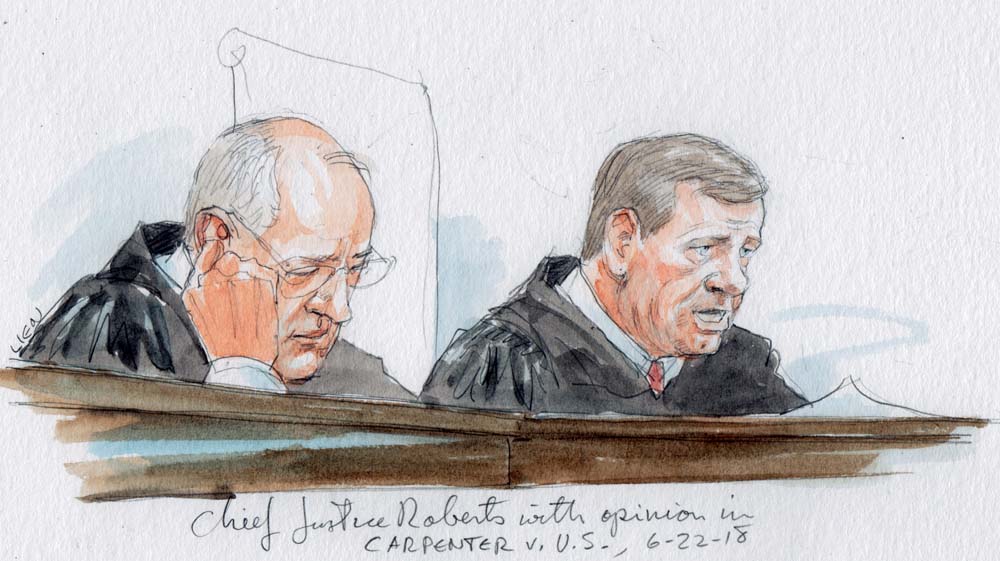
Opinion Analysis Court Holds That Police Will Generally Need A Warrant For Sustained Cellphone Location Information Updated Scotusblog

Carpenter V United States Scotusbrief Youtube